
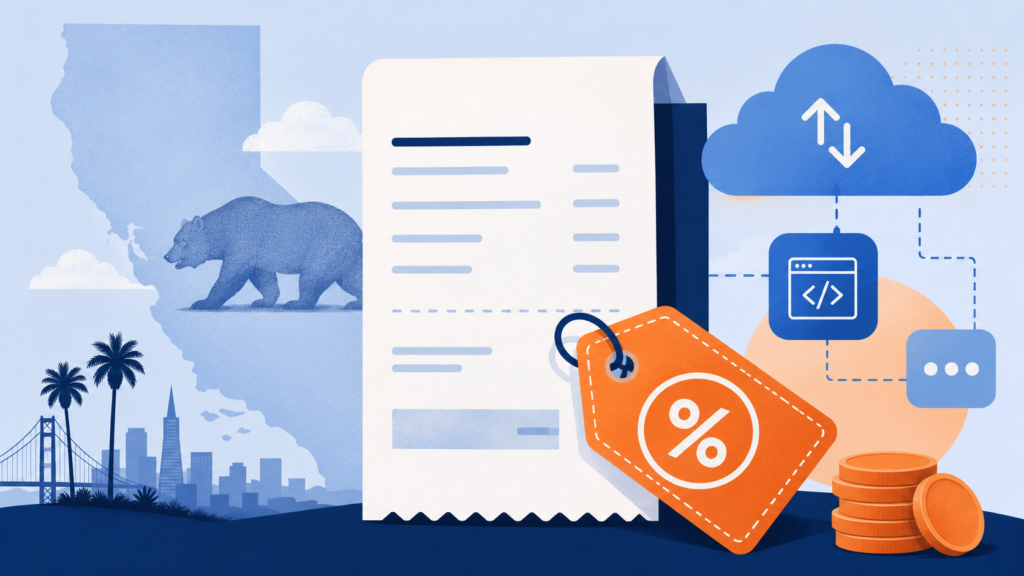
California Is Now Taxing Your Software Subscriptions. Here's What SB 122 Means for Los Angeles Businesses.
THE SHORT ANSWER
Governor Newsom signed SB 122 on June 29, 2026, making California the latest state to apply sales and use tax to SaaS subscriptions and prewritten software, effective January 1, 2027. Cloud-based software your Los Angeles business currently pays for tax-free, accounting platforms, CRM tools, cloud storage, practice management systems, will become subject to California’s 7.25% base rate plus local district taxes starting next year. The law is signed. The clock is running. Here is what changes, what it costs, and what your business needs to do before January 1.
IT Accuracy | Managed IT Services, Los Angeles | July 2026 | 8 min read
AT A GLANCE
Most Los Angeles businesses have never paid California sales tax on their cloud-based software services. That changes on January 1, 2027. Here is what the law actually says, what it will cost in real numbers, and what to do between now and then.
What Is SB 122 and What Did It Just Do?
California has historically not applied sales tax to software that is accessed remotely rather than physically delivered. A boxed piece of software on a disc was taxable. The same software accessed through a browser, the model almost every modern business uses, was not. That distinction made California unusual among major states, and it is now gone.
SB 122, signed by Governor Newsom on June 29, 2026, as part of California’s 2026-27 state budget, eliminates the delivery-method distinction entirely. Starting January 1, 2027, California’s sales and use tax applies to prewritten software regardless of how it is delivered, whether on physical media, downloaded, or accessed remotely as a cloud-based software service. For Los Angeles businesses that rely on SaaS tools for day-to-day operations, the practical effect is straightforward: your software subscriptions are about to get more expensive.
What Becomes Taxable Starting January 1, 2027?
The law defines “digital product” broadly. Any permanent or temporary right to open, view, access, download, copy, update, possess, store, manipulate, or otherwise use prewritten software, whether accessed remotely or downloaded, is now a taxable transaction in California.
In plain terms: if your business pays a monthly or annual subscription to use cloud-based software services hosted on someone else’s servers, that subscription becomes taxable in 2027. This covers the overwhelming majority of the modern SaaS stack, accounting software, CRM platforms, practice management systems, project management tools, cloud-based productivity suites, and cloud storage.
What stays exempt is worth knowing. Custom software built specifically for your business remains untaxed. The law also explicitly excludes digital books, digital music, streamed movies and video, video games, digital infrastructure, and cryptocurrency. If your business primarily uses off-the-shelf cloud-based software services, those exclusions will not help you. The tools most businesses pay for every month are precisely the ones now subject to tax.
What Does This Actually Cost a Los Angeles Business?
California’s base sales and use tax rate is 7.25%. Most Los Angeles-area locations add local district taxes on top of that, making the real rate typically 9% to 10.25% depending on your city and neighborhood.
$2,000/month SaaS spend
+$180–$205/mo
At combined LA-area rates of 9%–10.25%. That’s $2,160–$2,460 per year in new tax on existing tools.
$5,000/month SaaS spend
+$450–$512/mo
At combined LA-area rates of 9%–10.25%. That’s $5,400–$6,150 per year in new tax on existing tools.
Statewide base rate
7.25%
Plus local district taxes — most LA-area businesses will pay 9% to 10.25% combined.
Projected state revenue
$900M+
Annual general fund revenue estimate once fully operative. That money is coming from businesses like yours.
These are not hypothetical numbers. They are the direct cost of continuing to use the same cloud-based software services your business uses today, without adding a single new tool, once the tax takes effect. For businesses managing tighter margins, especially in sectors like hospitality, construction, or legal services, this is a real line item worth budgeting for now.
A Detail Worth Understanding: Who Actually Owes the Tax?
In most transactions, the seller, your software vendor, collects the sales tax and remits it to the state, the same way a retail store collects tax at checkout. SB 122 includes an important exception for larger purchasers.
If a business’s purchases of digital products from a single vendor exceed $5 million in the calendar year 2027, the obligation to self-assess and remit use tax shifts from the vendor to the purchaser. Beginning in 2028, the threshold applies to either the current or preceding calendar year. Most small and mid-size Los Angeles businesses will not reach this threshold with any single vendor, but it is a meaningful detail for any business approaching that level of software spend, since the compliance obligation falls directly on your accounting team rather than your vendor.
Implementation guidance still pending
The California Department of Tax and Fee Administration has not yet issued final implementing guidance on definitions, sourcing rules, and transition procedures. The law is in effect, but some technical details of how it applies to specific arrangements will depend on guidance that is still being finalized. Monitor CDTFA communications and consult your tax advisor before year-end 2026.
What Los Angeles Businesses Should Do Before January 1, 2027
Action steps for Los Angeles businesses
IT Accuracy — Managed IT Services, Los Angeles
We help Los Angeles businesses get a clear picture of their SaaS stack before the tax clock runs out.
As part of our managed IT services for Los Angeles businesses, we help clients keep their cloud-based software services and technology vendor relationships organized. That work becomes directly useful now, since the first thing you need before your accountant can calculate your SB 122 exposure is a complete, accurate list of what you’re actually paying for. We don’t provide tax advice — that’s your accountant’s role — but we can do the groundwork that makes that conversation faster and more accurate.
We’ve helped CPA firms, law firms, and small businesses across Los Angeles keep their technology vendor stack clean and documented. That documentation is exactly what SB 122 compliance prep requires.
IT Services topic cluster: related reading

Managed IT Services | Los Angeles, CA
IT Accuracy provides cybersecurity and security awareness training, managed network services, cloud solutions, and help desk support for businesses across Los Angeles and nationwide.